
January 21, 2013 | Daily Monitoring Report.

President Mohamud attends Arab Summit in Saudi Arabia
21 Jan – Source: Bar-kulan/Radio Mogadishu/Jowhar Online/Dhacdooyinka Online/Shabelle – 164 words
Somali President Hassan Sheikh Mohamud on Sunday night arrived in Riyadh, Saudi Arabia, where he will be attending the third Arab Economic and Social Development Summit aimed at finding common ground on crucial issues of trade, job creation, energy needs and disease prevention.
The summit will be attended by heads of state and ministers of 21 Arab countries. Issues on the agenda include ways to promote investment flows across all Arab nations, develop sources of renewable energy from 2010 to 2030, fulfill the 2000 to 2015 millennium development goals, fight non communicable diseases (NCD) and set up a youth forum in the Arab states.
Cardiovascular diseases, diabetes, cancer and chronic respiratory diseases will be highlighted among the other noncommunicable diseases (NCD) in the Arab world. It was felt that the NCDs are a significant burden on the economies and health systems of Arab countries. The meeting will also take up the recommendations from the Arab Private Sector Forum, which concluded last week in the capital.
Key Headlines
- President Mohamud attends Arab Summit in Saudi Arabia (Bar-kulan/Radio Mogadishu/Jowhar Online/Dhacdooyinka Online/Shabelle)
- Ahlu-Sunna urges Somali government to reach central regions (Radio Kulmiye)
- UK plans conference on Somalia; its Africa Director visits Addis Ababa (Walta Information Centre)
- Somali government asks other nations for recognition (Radio Kulmiye)
- Regional alliances shifting (African Confidential)
- Mohamud addresses Somali diaspora in United States (Sabahi Online)
- Relocation of urban refugees begins on Monday (NTV)
- Somali university students deterred by high fees rather than civil war (The Guardian)
PRESS RELEASE
AU Special Representative Shocked and Saddened by the Continuing Trend of Journalist Assassinations
18 Jan – Source: AMISOM – 167 words
The Special Representative of the Chairperson of the African Union Commission (SRCC) for Somalia, Ambassador Mahamat Saleh Annadif is shocked and saddened by the continuing trend of assassinations and harassment of journalists in Somalia.
Ambassador Annadif has condemned the killing of Shabelle Media Network journalist, Mr. Abdihared Osman Adan who was shot as he was leaving his house on his way to his work place.
“It is sad to note that this barbaric behavior continues to exist despite the relative peace and security that Mogadishu is currently enjoying. It is very critical that stakeholders as a matter of priority and urgency put their heads together and bring to an end this trend once and for all.” He said.
The AU Special Representative said as the country is making tremendous progress on both the political and security fronts, members of the media should be given assurance that their work environment is safe to operate in to ensure the Somali people are well informed of the developments around them.
UN Special Representative for Somalia statement on assassination of Somali journalist Abdihared Osman Adan
18 Jan – Source: UNPOS – 245 words
The Special Representative of the Secretary-General for Somalia, Dr. Augustine P. Mahiga today condemned the murder of Shabelle radio journalist Abdihared Osman Adan, who was shot and killed by unidentified gunmen earlier today in Mogadishu.
“This is the latest in the series of heinous killings targeting the Somali media community” said SRSG Mahiga. Eighteen journalists were killed in Somalia last year alone.
“I call on the Government to expedite the formation of the task force announced by President Hassan Sheikh in November. It’s deplorable that the perpetrators continue to enjoy impunity, while the Somali media community continues to be targeted” SRSG Mahiga added.
In November last year President Hassan Sheikh called on Prime Minister Shirdon to set up a Task Force to thoroughly and urgently investigate all cases involving the killing of Somali journalists with a view to bring those responsible to justice.
“Free and independent media is the backbone of a democratic state and egalitarian society. Every violent attack against the media is an attack against transparent governance. Freedom of expression is guaranteed under Somalia’s provisional constitution as well as Somalia’s international commitments” Dr. Mahiga said. The SRSG extended his condolences to Abdihared Osman Adan’s family and friends, to Shabelle Media Network and to the Somali media community.
SOMALI MEDIA
President Mohamud attends Arab Summit in Saudi Arabia
21 Jan – Source: Bar-kulan/Radio Mogadishu/Jowhar Online/Dhacdooyinka Online/Shabelle – 164 words
Somali President Hassan Sheikh Mohamud on Sunday night arrived in Riyadh, Saudi Arabia, where he will be attending the third Arab Economic and Social Development Summit aimed at finding common ground on crucial issues of trade, job creation, energy needs and disease prevention.
The summit will be attended by heads of state and ministers of 21 Arab countries. Issues on the agenda include ways to promote investment flows across all Arab nations, develop sources of renewable energy from 2010 to 2030, fulfill the 2000 to 2015 millennium development goals, fight non communicable diseases (NCD) and set up a youth forum in the Arab states.
Cardiovascular diseases, diabetes, cancer and chronic respiratory diseases will be highlighted among the other noncommunicable diseases (NCD) in the Arab world. It was felt that the NCDs are a significant burden on the economies and health systems of Arab countries. The meeting will also take up the recommendations from the Arab Private Sector Forum, which concluded last week in the capital.
Ahlu-Sunna urges Somali government to reach central regions
21 Jan – Source: Radio Kulmiye – 111 words
The Chairman of the Executive Committee of the Ahlu-Sunna Wal jama’a Sheikh Mohamed Yussef “Hefow” has requested the Somali government to make their power reach the districts administered by the Sufi group.
Hefow explained that the people living in the central regions in the country need the government after his group lifted the burden of militants group from the residents. The Chairman of the Executive Committee of the Ahlu-Sunna Wal Jama’a vowed to redouble their efforts to get rid of the al Shabaab militants.
Alleged soldier kills civilian in Jowhar
20 Jan – Source: Bar-kulan – 113 words
A gunman said to be a Somali government soldier on Sunday shot dead a taxi driver in Jowhar town under unknown circumstances. The errant officer shot the taxi driver after picking a quarrel with him, according to eyewitnesses account.
The assailant was immediately apprehended by his colleague, they added. Local authorities are yet to comment the incident that shocked locals in the town as the assailant was said to have been a government soldier.
The incident comes four days after two soldiers were executed in Mogadishu for murder and rape cases. The two were executed on Wednesday after a military Court last year condemned them to death for murder and rape charges.
Somali government asks other nations for recognition
20 Jan – Source: Radio Kulmiye – 92 words
Somali Prime Minister Abdi Farah Shirdon ‘Saa’id’ has called on nations around the world to follow Us suit and recognise the Somali government. Speaking to the press in Mogadishu, Prime Minister Saa’id said the recognition by the United States of his government will pave the way for Somali citizens to enjoy just like other African citizens.
His remarks comes days after American government under the leadership of President Barack Obama officially recognized the Somali government after more than 20 years of diplomatic blackout.
Somaliland: Modern surveillance equipment at airport
19 Jan – Source: Somaliland Press – 111 words
The Head of the Immigration Department Col. Mohamed Ali Yusuf has unveiled new state of the art surveillance equipment to be used at the Berbera airport.
The head of Immigration told reporters, “We have finished the training of immigration officials on frontier and immigration management” and added “We have now installed the important Personal Registration and Identification System (PIRS) equipment so as to enhance effectiveness of their work by using the new facilities at the Berbera International airport.”
Col. Mohamed said the new equipment which has been installed at the Berbera international airport has the capability to generate statistics and thus inform on immigration trends, it provides data useful for the immigration.
REGIONAL MEDIA
UK plans conference on Somalia; its Africa Director visits Addis Ababa
20 Jan – Source: Walta Information Centre – 759 words
The Office of the United Kingdom’s Prime Minister, David Cameron, announced that Britain plans to host another international conference on the future of Somalia on May 7th. This will build on the conference on Somalia held in London in February last year where some 50 governments and international organizations, including US Secretary of State Hillary Clinton and UN Secretary General, Ban ki-Moon, pledged to boost aid for Somalia to help fight Islamist militants and pirates.
A follow-up conference, attended by 54 countries, was also held in Istanbul in June. The new conference is intended to help sustain international support for the progress being made by the Somali government. Somalia’s Foreign Minister was in London last week, and Mr. Cameron’s office said he had spoken with Somali President Hassan Sheikh Mohamud on Thursday last week and discussed the progress made against Al-Shabaab forces, as well as President Hassan’s priorities in restoring stability in Somalia.
Prime Minister Cameron said he would use the UK’s Presidency of the G8 this year to reinforce further support for the efforts of the Somali government to build a strong, prosperous and democratic country. The United Kingdom said last week that it would be working closely with both the African Union and Ethiopia during its G8 Presidency this year on a number of areas including Somalia as well as the New Alliance on Food Security and on improving G8-African Union co-ordination on peace and security matters.
Prime Minister Cameron has said the UK’s Presidency of the G8 will focus on three ways in which the G8 can support the development of open economies, open governments and open societies to unleash the power of the private sector: advancing trade, ensuring tax compliance and promoting greater transparency.
Kenya links Somali gangs to increased wildlife poaching
20 Jan – Source: Daily Nation – 580 words
Gangs from neighbouring Somalia and former game rangers are behind the stepped-up poaching of Kenyan wildlife, a senior government official says. Head of Public Service Francis Kimemia says he has directed the Kenya Wildlife Service (KWS) top leadership to investigate and furnish the Office of the President with findings into the Somalia link.
Just last week, a gang of 10 poachers killed a family of 11 elephants in Tsavo National Park in the illegal hunt for tusks. In total, Kenya lost 375 elephants and 20 rhinos to poaching in the past year compared to 289 elephants and 29 rhinos the year before.
Mohamud addresses Somali diaspora in United States
20 Jan – Source: Sabahi Online – 124 words
Somali President Hassan Sheikh Mohamud addressed nearly 4,000 Somali expatriates in the state of Minnesota on Friday (January 18th), the BBC reported.
Mohamud encouraged Somalis in the diaspora to do their part to rebuild Somalia, either from their homes in the United States or by returning to their country.
Mohamud’s speech, delivered mostly in Somalia, was warmly received by his audience, although about 50 people protested outside the convention centre, disagreeing with the president on policy issues. Minnesota is home to the largest Somali population in the United States, with an estimated 70,000 Somalis.
Relocation of urban refugees begins on Monday
19 Jan – Source: NTV – 3:09 min
The relocation of refugees living in urban centres begins this Monday. NTV has obtained a letter from the permanent secretary internal security Mutea Iringo requesting his special programmes counterpart to provide relief to the refugees who will initially be held at Thika Stadium.
Leaders from the Somali community have protested against the move saying it was discriminatory and politically motivated. Last December, the government issued a directive asking all Somali refugees and asylum seekers living in Eastleigh and other towns to move to the Dadaab refugee camp or be rounded up.
Kenyan manufacturers eyeing Somalia market
18 Jan – Source: Star – 289 words
Kenya’s business community is raring to venture into Somalia as soon as security threats are minimized to acceptable levels for investors to feel their businesses would survive.
Kenya Association of Manufacturers chairman Polycarp Igathe says the ongoing stabilization of Somalia’s security is a boost to Kenya’s ambitions to expand into that country.
“We are ready to invest in Somalia especially in the infrastructure sectors and manufacturing and we hope the basic state structures are put in place soon,” said Igathe.
He was speaking after a meeting with the Chief of Defense Forces General Julius Karangi, who assured them that the al Shabaab threat has been sufficiently minimized.
INTERNATIONAL MEDIA
Somali university students deterred by high fees rather than civil war
21 Jan – Source: The Guardian -826 words
For University students in Somalia, the threat of violence has been the biggest concern in recent years. But as peace returns to the capital, Mogadishu, high tuition fees rather than civil war are more of a barrier for students wishing to attend classes.
Despite the civil war that has lasted more than two decades, education remains key for many Somalis. “To be without knowledge is to be without light” is a popular Somali proverb. Rather than closing campuses, some universities chose to relocate at the height of the conflict – but many are now back in Mogadishu.
“Somalis are very resilient people. Despite the wars, famine and displacement, students and staff still turned up to classes. When our classes were destroyed, we taught under the trees. We refused to close our doors because you never know when war will end,” says Professor Mohamed Abdiweli Ali, chancellor at the University of Somalia, who is also a presidential candidate and a former lecturer at King’s College London.
The University of Somalia was the first to move from Mogadishu to Elasha Biyaha, just outside the capital. This was in 2006, during the Ethiopian invasion, when many students and staff faced harassment by both the Islamist al Shabaab militia and Ethiopian troops.
Somali Government to resettle Mogadishu IDPs
20 Jan – Source: Press TV – 216 words
The Somali Interior and National Security Ministry has announced plans to relocate thousands of displaced families living in camps all across Mogadishu.
The announcement was made by the Interior and National Security Minister Abdikarim Hussein Guled after meeting representatives of both local and international aid agencies in Mogadishu. The local Mogadishu municipality hopes to refurbish the capital as the government is also busy renovating the badly ruined state buildings and offices.
Muslim countries among them Turkey and Iran began the process of returning the displaced to their homes a year ago after the United Nations declared an end to famine in South and Central regions of Somalia.
Regional alliances shifting
21 Jan – Source: Africa Confidential – 965 words
For weeks, diplomats in Kenya have fretted about the brewing discord between President Hassan Sheikh Mohamud of Somalia and Mwai Kibaki of Kenya. They finally met in Nairobi just before Christmas to try to iron out differences over how the southern Somali region of Jubaland should be governed.
Against Hassan Sheikh’s orders, Kenya allows Ahmed Mohamed Islaan ‘Madobe’, leader of its local ally, the Ras Kamboni militia, to profit from the export of stockpiles of charcoal from Kismayo port (AC Vol 53 Nos 20 & 22). Many Western governments support Hassan’s position, but they are reluctant to defy Kenya publicly. Meanwhile, a wider geopolitical split is emerging over Somalia, pitting traditional allies Kenya and Ethiopia against Eritrea, Qatar and others.
Despite warnings about the political and military dangers from the other countries involved, the Kenyan army allows Madobe, a Darod/Ogadeni, to run the port as a personal fiefdom, say sources close to Hassan Sheikh. They also talk of skirmishes between Madobe’s troops and the Somali National Army (SNA) in Kismayo. Madobe’s troops and rival armed units from the Marehan clan clashed on 20 December, leaving eight people dead. Kismayo has a long history of clan infighting for control of the port, which Al Haraka al Shabaab al Mujahideen has exploited on occasion.
Darod clan elders claim that in early November, Hassan Sheikh dispatched SNA General Mohamed Roble Jimale ‘Gobale’ (Hawiye/Habr Gidir/Ayr) and a representative of the warlord Yusuf Mohamed Siad ‘Indha Adde’ (Hawiye/Habr Gidir/Ayr) to Kismayo to read the riot act to Madobe. If true, this could mean that the new President is making concessions to a Habr Gidir/Ayr pressure group which claims it has been unjustly excluded from power ever since Ethiopia’s 2006 invasion, when it dismantled the Islamic Courts Union, to which Indha Adde belonged.
The fear now is that Ayr leaders could reactivate old alliances with Darod/Marehan factions that once vied for control of Kismayo, disrupting a delicate alliance between Kenya and Ethiopia, which backed the Marehan.
SOCIAL MEDIA
CULTURE / OPINION / EDITORIAL / ANALYSIS / BLOGS/ DISCUSSION BOARDS
“A loose union between the two states may well be a workable solution and if stances continue to soften a more pragmatic approach to Somaliland’s future could be emerging. Yet it is highly unlikely that the upcoming negotiations will result in any agreement. Politicians on both sides are still mindful of the need to be seen to be sticking up for their people and this means not making any concessions.”
A third way for Somaliland and Somalia
18 Jan – Source: Commentator/Somaliland Press – 992 Words
Negotiations between the governments of Somalia and the autonomous breakaway state of Somaliland are set to resume within the next month. The question of Somaliland’s status as an independent country or as a region within Somalia has previously proven impossible to resolve. However, a softening of attitudes in Somaliland and the appointment of Fawzia Adan, a Somalilander sympathetic to the desire for independence, as Somalia’s Foreign Minister is creating hope that with time progress can be made.
The two governments are starting talks from very different positions. Whilst the government of Somalia wants to form a united republic with Somaliland, the Somaliland government has long rejected this. Instead the government in Hargeisa has been attempting to gain international recognition of its statehood ever since it declared its independence from Somalia in 1991.
These attempts have been unsuccessful and Somaliland has made little progress in achieving its goal. Although many countries accept that Somaliland fulfils legal criteria for statehood, none of them have recognised it. In Hargeisa the blame for this is placed at the door of their southern neighbours and the geopolitical interests of the international community.
“Diaspora-led investment in new industries has been a central driver of economic growth. Continuing to create greater opportunities for overseas investment, particularly through the diaspora, must remain high on the agenda if the current hopes for a more prosperous economic future are to be fully realised.”
How diaspora investment is proving to be a magic lamp across the Horn of Africa
19 Jan – Source: East African – 1104 Words
According to the latest estimates from the African Development Bank (AfDB), the economies of the Horn of Africa struggled to rebound last year after the devastating drought of 2011.
Figures show that after a modest recovery from the worst of the global financial crisis in 2008/09, the famine and mass displacement that struck Somalia, Djibouti, Ethiopia and Kenya dragged East Africa’s overall growth rate down from 7 per cent in 2010 to just over 5 per cent in 2012.
By contrast, the growth rate for the continent overall rose between 2011/12 from 3.5 per cent to 4.5 per cent.
Definitions of the Horn of Africa vary — with Kenya, Sudan and South Sudan often included — but if we look specifically at the region encompassing Eritrea, Djibouti, Ethiopia and Somalia, the impact of the drought is even more striking.
“Somalia is at a crucial stage, having moved from a transitional to an elected government. The country needs the total support of the continental body as it seeks to stabilise itself for the first time after 21 years, but as al Shabaab still continue to threaten this process.”
African Union is 50; time to take responsibility?
19 Jan – Source- East African – 259 Words
The African Union, formerly the Organisation of African Unity, will be celebrating its Golden Jubilee this year; what does it have to show for the past 50 years?
Successful deployment of peacekeeping forces in Somalia remains one the strongest achievements of the continental body, given that they have succeeded where stronger forces failed.
As African leaders gather in Addis Ababa for the 20th Summit this week, they will be faced with the issue of political upheavals in virtually all the five regions of the continent.
Yet the theme of the summit is “Year of Pan-Africanism and African Renaissance.” Our leaders seem more interested in celebrating than tackling security problems across the continent.
Somalia President Visits Minneapolis – Somalia MN 2013
21 Jan – Source: Storify – 308 Words
On January 18, 2013, Somalia’s newly elected President Hassan Mohamud and members of his delegation visited Minneapolis, Minnesota to address the Somali-American community, home to the largest Somali diaspora community in the United States. It was President Mohamud’s first visit to the States.
He arrived from Washington, D.C. where he met with President Barack Obama and Secretary of State Hillary Clinton and Members of Congress. Mohamud was joined by Somalia’s first female Foreign Affairs Minister & Deputy Prime Minister, Fawzia Yusuf Adem.
After a rousing introduction by Congressman Keith Ellison, President Mohamud and his delegation addressed the crowd of 5000 people, laying out the new government’s priorities for Somalia. His remarks were warmly received by the attendees, who waved Somali and American flags throughout his speech. Despite the warm reception inside, a crowd of protesters stood outside holding signs against Somalia’s 2011 elections and demanding the government adhere to a federalist structure. Although Mohamud’s speech was not available on livestream due to logistical difficulties, it is available on YouTube and below in this story.
As soon as I walked into the Minneapolis Convention Center, I felt right at home as soon as I saw the huge crowd, long lines, and people buzzing with excitement. It reminded me of the early days when Eritrea’s diaspora held conventions and festivals to support our struggle for independence. The popular EPLF musicians & activists would organize international tours and I remember we would all flock to the designated city for a rare sighting and celebration with our community members. It was that kind of feeling. Reunions, rumors, families, children everywhere, teenagers trying to act like they’re too cool for the event but clearly excited. It’s the heart of so many diaspora communities. I’m not Somali, and yet, I still felt like I could relate to that excitement. Anyway, I digress….Here’s my summary:
Why did Somalia fall apart so badly?
19 Jan – Source: Alternate History Forum – 77 Words
Lots of countries have had civil wars, in recent years this number has grown to include Libya, Nigeria, Angola, Mozambique, Chad and Sierra Leone. Yet none of these countries have had such a comprehensive collapse of government authority as Somalia and I’m curious as to why this is. Was the Barre regime particularly effective at stoking sectarian unrest? Or is Somalia made up of a higher number of different tribes, which makes forming a cohesive government difficult?
Top tweets
@StateDept Now on #DipNote — Photo of the Week: U.S. Recognizes the Government of #Somalia http://go.usa.gov/4jVF.
@Tarey_A #SomaliaRising: comrades I think the winds of change is blowing beautifully our white-stared flag. #Somalia is open 4 business in 2013.
@Semhar #Somalia: In case you missed my #SomaliaMN2013livetweets,here’s a Storify roundup: http://tinyurl.com/bynu2jt @Africathinker @Hamza_Africa @Aynte.
@Hamza_Africa Full house for a females basketball game in#Mogadishu, #Somalia. Soldiers making sure play is not to be disrupted! pic.twitter.com/sJuxoWLO.
@JamesGadin #Somalia Police Officers departing for Training in Djibouti to be conducted by #AMISOM and #Italian Caribinieri –http://www.facebook.com/media/
Image of the day
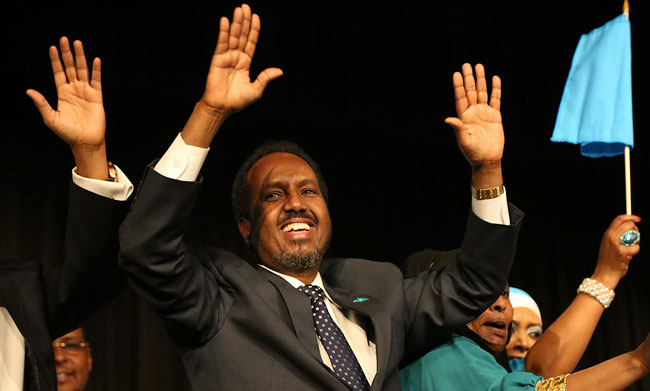 Somali President Hassan Sheikh Mohamud waves at the crowds as he comes onto the stage during a gathering at the Minneapolis Convention Center on Friday Jan. 18, 2013. Photo: AP.